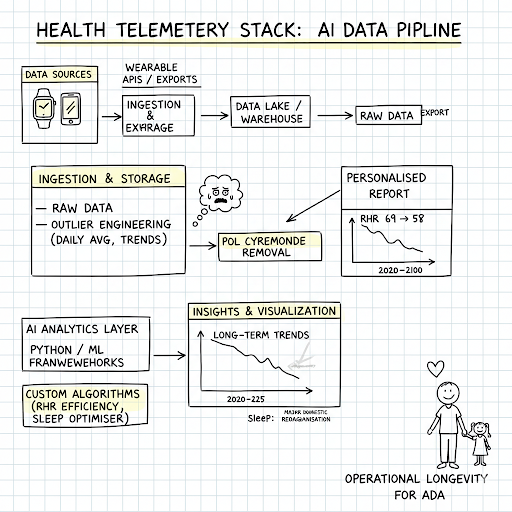
The breakthrough came when I stopped treating the wearable as a “coach” and started treating it as a sensor.
Strategic Summary
- The Risk: Blindly following “black box” AI health advice.
- The Solution: Custom data wrangling and multi-year trend analysis.
- Status: Mission success confirmed by raw data, not app badges.
I’ve been a health data geek since the Nike+ shoe sensor era. What started as curiosity evolved into a full-scale surveillance mission on my own biology. By leveraging AI to parse a decade of movement and heart rate trends, I’ve extracted actionable intelligence that not a single health professional has ever asked to see. It’s a strange tactical oversight: we have the telemetry, but it remains siloed from the people managing our care.
I don’t blame them. Consumer wearable data is often wildly inaccurate, and off-the-shelf AI “coaching” can be nonsensical or even dangerous. I wasn’t interested in generic app badges; I wanted the raw data wrangling. As a geek and dad to Ada, the objective is simple: operational longevity. I didn’t need arbitrary goals; I needed to validate that my plan is actually working.
The Protocol
To move from noise to insight, I followed a three-stage pipeline to process over 130,000 data points:
- Extract: Pull the raw JSON/CSV from the siloed apps.
- Clean: Filter out the nonsensical outliers (like the time my watch thought I was sprinting at 140 bpm while I was actually just having a very intense technical debate).
- Validate: Match the trends against objective outcomes (RHR, Deep Sleep percentages, steps, etc.).
Tactical Results
The Desk-Job Battle
To counter the environmental hazard of a desk, I average 13,598 steps daily. My Resting Heart Rate (RHR) dropped from 69 bpm in 2019 to 58 bpm today. My heart is more efficient now than in my mid-thirties.
Logistics & Recovery
I maintain a tactical vulnerability to gummy bears. My high activity levels provide a metabolic buffer; performance is literally fueled by sugar.
Sleep Architecture
My 20:00–21:00 (Detroit) bedtime ensures 15.2% deep sleep and 20.2% REM, keeping me fully operational for the morning shift with Ada. With that said, history in the military and farming has not helped with the longevity.
Subject Dossier: Nicholas Schmidt
| Metric | Status |
|---|---|
| Classification | Desk-bound / High-Volume Movement |
| Validation Status | Plan confirmed via AI data wrangling |
| Daily Activity | 13,598 steps/day |
| Vitality | RHR improved from 69 to 58 bpm |
| Sleep | Still Sucks |
Conclusion
AI is finally bridging the gap between messy wearable data and medical insights. You can work from a desk, love gummy bears, and maintain a “dad schedule” while possessing the cardiovascular profile of an athlete. I didn’t need a goal; I just needed the data to prove I was on the right track.