I am a sucker for good design and character.
In a world of mass produced replicas, there is something genuine about the feel of an error. It is that slight non perfection that proves a human hand was at work. For the majority of my kit, I want the perfect version, but the definition of perfection is shifting.
Coding with AI currently occupies a curious mental space. I recognise the future and I accept the new methodology is upon us. Yet, I wonder if we are headed toward a world of Artisanal Code or Boutique Hand Written software, much like the resurgence of vinyl or analogue horology.
Coding is a triad: part art, part science, and part engineering. The question is what that looks like in twenty years.
My perspective is shaped by a specific transition. I grew up moving from the Commodore 64 to PCs, then to UNIX. I watched the digital landscape evolve from BBSs and Gopher to the World Wide Web. Retro still sells for millions, but I am not under the illusion that my Commodore is as useful as my Linux laptops. It is a matter of utility versus nostalgia.
We are approaching a crossroads similar to engine design. We moved from carburetors to fuel injection, and eventually to computers with wheels. I can still change the oil and brakes on an older vehicle. On a modern machine, however, the environment is increasingly hostile to non manufacturer intervention.
This is why Right to Repair is no longer a niche hobby. It is a cultural necessity. We are forced to consider what ownership actually means when you are essentially renting your assets and dealing with mounting e waste.
As AI programming becomes the standard, we face a new kind of “closed hood.” If a model generates a million lines of code that no human can easily parse, we lose the ability to maintain or audit our own systems.
The future of Right to Repair must include the right to transparency: the open source review of the algorithms and logic that govern our digital lives. Without access to the underlying logic, we cannot fix what is broken or ensure that the engine is actually working in our best interest. Open source is the digital equivalent of a shop manual. It ensures that even in an AI driven world, we retain the agency to inspect, understand, and repair the tools we depend on.
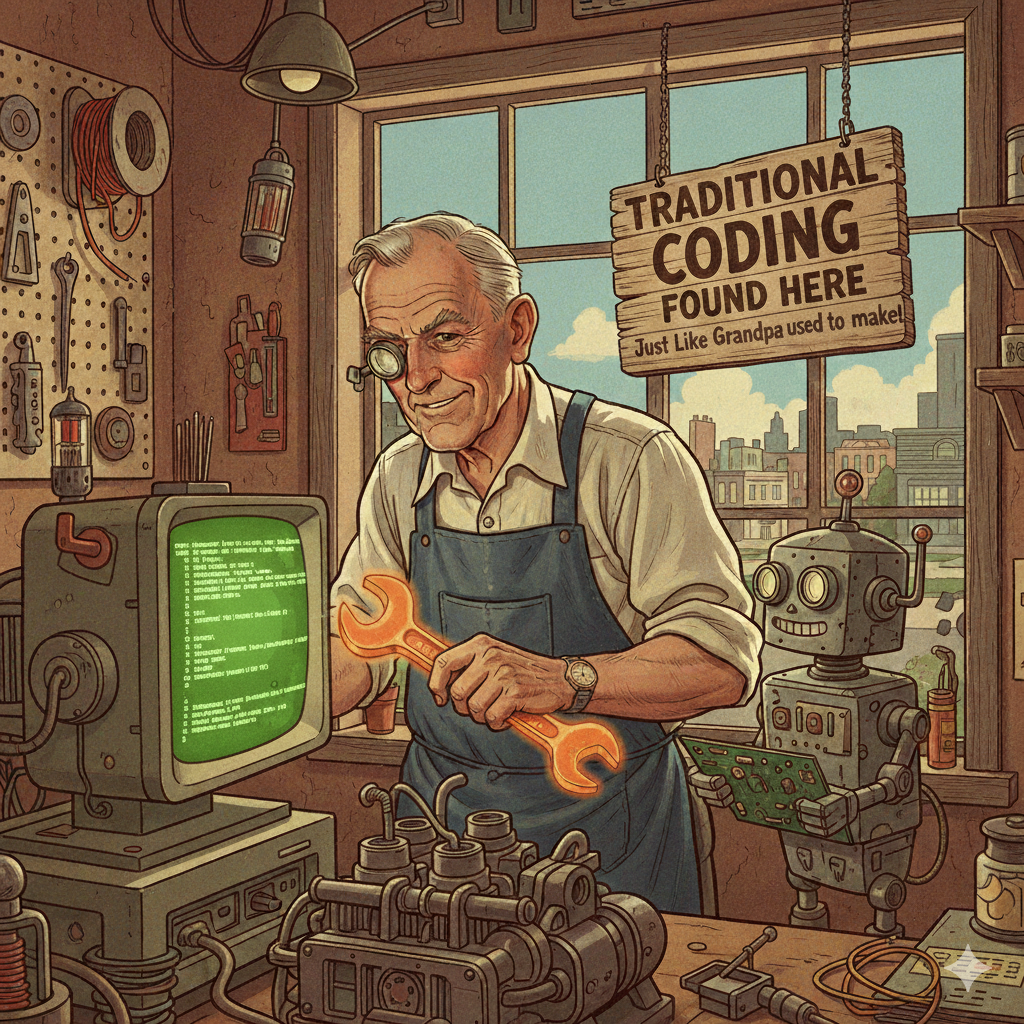
The architecture of code will continue to progress at breakneck speed. Efficiency will dictate the terms. But I still have this vision: a small sign by the side of the road, similar to those for small engine repair, that simply reads:
“Traditional Coding Found Here. Just like grandpa used to make.”