My dad had shortwave radios. Proper ones. The kind with a dial that glowed, a tuning knob the size of a hockey puck, and a weight to the chassis that suggested the builder expected it to survive a nuclear exchange. Later came the big ham rigs, boxes the size of a suitcase with heat sinks, a morse key, and meters for things I didn’t yet have names for. Antennas went up in the yard. Cables went everywhere. The living room smelled faintly of solder.
And none of it was off limits. My father and I spent my years growing up building antennas and learning how the whole thing worked, as part of our ham radio hobby. Wire thrown over tree branches, clip leads, solder smoke on the kitchen table. I learned why signals skip off the ionosphere before I’d learned long division.
What I remember most is the sound. The two of us turning the dial slowly through the shortwave bands at night, and out of the static: a station in another language, then another one further away, then the eerie warble of numbers stations. A wire in the yard pulling voices out of the sky. Understanding the mechanics never killed the magic. RF still feels like weather with a licence.
Forty-odd years later, I bought a radio the size of a playing card that does most of what those rigs did. It cost about twenty bucks. It’s called the ATS-Mini, and it’s quietly one of the best teaching tools for RF I’ve come across.
What It Actually Is
Strip the marketing off and the ATS-Mini is:
- An ESP32-S3 microcontroller doing the thinking
- A Si4732 DSP chip doing the receiving
- A 1.9 inch colour TFT and a rotary encoder
- A battery, a case, and not much else
Here’s the bit that would have melted my dad’s mind: the Si4732 is a single-chip receiver. The antenna signal goes in, a slice of spectrum comes out, and everything you hear happens in firmware. Filtering, demodulation, AGC, all of it in code. That’s the textbook definition of a software-defined radio (SDR), even though the purists reserve the term for gear like the RTL-SDR dongles and HackRFs where the raw IQ samples land on your computer.
It receives LW, MW, the world shortwave bands, FM with RDS, and the amateur bands. SSB included. So a teenager today can hear the same late-night magic I heard off my dad’s dial, on a device that fits in a shirt pocket, for less than the cost of a takeaway lunch. Progress looks weird sometimes.
SDRs Have Been Running Through My Whole Career
For me, SDRs started as a hobby and refused to stay one.
Long before I landed in energy markets, they were part of my professional toolkit. Anytime a project involved wireless gear, an SDR was how I answered the questions a datasheet wouldn’t. Is the radio actually transmitting? Is anything else stomping on this channel? Why does this IoT device drop offline every afternoon at 16:00? Spectrum analyser rentals cost real money. A thirty dollar dongle and free software answered most of it, and let me watch interference happen live instead of theorising about it after the fact.
The hobby fed the job and the job fed the hobby. Learning to read a waterfall plot for fun turned out to be career training in disguise. Which is a pattern worth naming: the skills you build for the joy of it tend to show up later, invoice in hand.
Energy markets eventually pulled my professional life toward the power grid, and that’s where the story loops back on itself. Because the grid and the RF spectrum collide at a very specific point in your house: the smart meter. More on that shortly. First, some magic.
Where the Magic Comes In
Now, about RF being magic disguised as science.
The maths is rigorous. Maxwell’s equations do not have feelings. But stand in a field with a receiver and try to explain what you’re hearing:
- Why does this frequency skip in from Italy at 21:00 and vanish by 22:00? Ionospheric propagation. The ionosphere changes with sunlight, and the sun doesn’t publish a schedule.
- Why is the signal different two metres to your left? Multipath. Reflections off buildings, hills and the neighbour’s shed combine in and out of phase. Move the antenna 30 centimetres and you’ve effectively rebuilt your aerial.
- Why does the receiver hear everything except what you actually want? Harmonics, and intermodulation from two strong local carriers mixing in the front end, plus every switching power supply in the county whining across the HF bands like a cloud of mosquitoes.
The physics is deterministic. The environment is chaos. So the craft ends up part science, part witchcraft. You wind a coil, hoist some wire, adjust, and listen. My dad and I did exactly that, hundreds of times: clip lead to wire, wire to tree, swear, tune, grin. Nobody fully simulates the electromagnetic soup that is a house and a hillside.
The rig got smaller. The soup stayed the same.
Chasing the BBC From the Wrong Side of the Pond
Here’s a concrete game that proves the point. The BBC World Service stopped broadcasting shortwave directly to the US and Canada back in 2008. Officially, if you want the Beeb over here, you use the internet like a civilised person.
The frequencies the BBC aims at West Africa and the Caribbean bounce off the ionosphere, and some of them land here. According to Radio World, the BBC itself confirmed decent North American reception reports on these frequencies after the cuts. Ones to try:
- 5975 kHz, 23:00 to 04:00 GMT
- 9915 kHz, 00:00 to 03:00 GMT
- 12095 kHz, 21:00 to 03:00 GMT
- 9410 kHz, around 05:00 GMT, beamed from Woofferton in the UK
- 15400 kHz, weekday evenings around 18:00 to 19:00 GMT
Convert GMT to your local time and go hunting. Some nights: nothing but static. Other nights: a newsreader in an RP accent arriving loud and clear from six thousand kilometres away, on a frequency aimed at somebody else entirely. Same transmitter, same power, completely different outcome. If that’s not a live demonstration that RF is part weather, part voodoo, I don’t know what is.
One caveat: the BBC reshuffles its shortwave schedule every six months with the seasons, and frequencies aimed at other regions can disappear without notice. Check the current global shortwave frequency table on the BBC site before you plan an evening around a specific number. The uncertainty is part of the sport.
Software-Defined Everything
The ATS-Mini is a distillation of a bigger shift. Twenty years ago a radio was capacitors, coils and hand-aligned crystal filters. Now the radio is an ADC, a processor, and firmware. The RF hardware’s only job is getting the signal into the digital domain as early as possible. Software handles the rest.
Same story up the whole market, from thirty dollar RTL-SDR dongles, which are repurposed TV tuners, to professional gear costing more than my truck. One consequence matters more than the rest: features became firmware, and firmware is updatable forever. This radio does more than the day it shipped because hobbyists kept writing. My dad’s rigs did exactly what the factory put in them on the day they left it, and that was that. There’s a version of that comparison sitting in almost every industry right now.
For the embedded nerds: the barrier to building a radio has dropped from years of RF apprenticeship to “can compile Arduino code.” Whether that’s a triumph or a warning depends on the week.
Smart Meters: Your House Is Already Transmitting
Which brings me to the cupboard, the garage wall, or wherever your meter hangs.
I’ve written before about devices that phone home. The treadmill saga is the famous one in this house. Smart meters are that argument, amplified. In North America, depending on your utility and meter generation, the meter is likely doing one of these:
- Broadcasting meter readings over a one-way radio link in the 902 to 928 MHz ISM band. This is the classic Itron ERT-style “encoder receiver technology” payload, and drive-by collection vehicles have been gobbling these transmissions up for decades.
- Running a mesh network, hopping meter to meter in the same 900 MHz band until the traffic reaches a collector or a cellular backhaul.
- Using power line carrier, which sends the data down the mains wiring itself and never touches the RF spectrum at all. No RF, no SDR, and ironically no easy way for you to watch it either.
Here’s the part that surprises people: in a lot of North American deployments, the meter’s radio transmission is plainly readable. Utilities deployed these one-way broadcast formats long before anyone thought about encryption, and legacy compatibility keeps them alive. If you have one of those meters, the consumption data is quite literally shouted into your neighbourhood at 900 MHz on a schedule.
You do not need a lab to hear it. This is the classic entry-level project in the RF side of the smart grid world:
- A $30 RTL-SDR dongle on a Raspberry Pi
- An open-source decoder like rtlamr
- An afternoon’s worth of patience
rtlamr listens in the 900 MHz band and decodes the meter broadcasts directly, printing your consumption readings to a terminal. Meter ID, consumption counter, the lot, in plaintext. I ran this setup back when I was cutting my teeth on SDRs professionally, and watching my own house’s data scroll past in cleartext was a formative moment. The grid was transmitting; all I did was listen.
Let’s be precise about the ethics here, because this blog doesn’t do hand-wavy: reading the broadcast from your own meter to understand your own consumption is observation. Tampering with the meter is a felony, and messing with anyone else’s readings is a very fast way to meet people with badges. Hear the difference between learning and interfering, and stay on the correct side of it.
Now put this next to the ATS-Mini on my desk. One came from a factory I can email, running firmware I can read, flash and improve, in a tradition where tinkerers are thanked in the changelog. The other is bolted to my wall, bills me monthly, and transmits from a device I’m not allowed to open. My dad would have had that meter’s spectrum mapped within a fortnight, and honestly, I’d have been right there holding the clipboard. If it transmits in your house, you ought to be able to know what it’s saying.
Verdict
The ATS-Mini is not a serious DX rig. The audio is quiet because the case is tiny, so use external speakers or headphones. The controls are menu-deep. The stock antenna is optimistic. But for twenty bucks you get:
- A working multiband receiver, SSB included
- A crash course in SDR architecture
- Proof that firmware is the product
- A reminder that the air around you is busier than you think
Buy one. Put it by a window. Hunt for 5975 kHz after dinner and see if the BBC snuck in over the pole tonight. Or park it on 7.2 MHz in the evening and listen to strangers talking across an ocean on bits of wire. I did that last month, and for about ten minutes I was seven years old again, wire in hand, standing next to my dad under the tree that held half our antenna farm.
Then glance at the smart meter on the wall and wonder what it’s saying about you. With a dongle and an afternoon, you can stop wondering and find out.
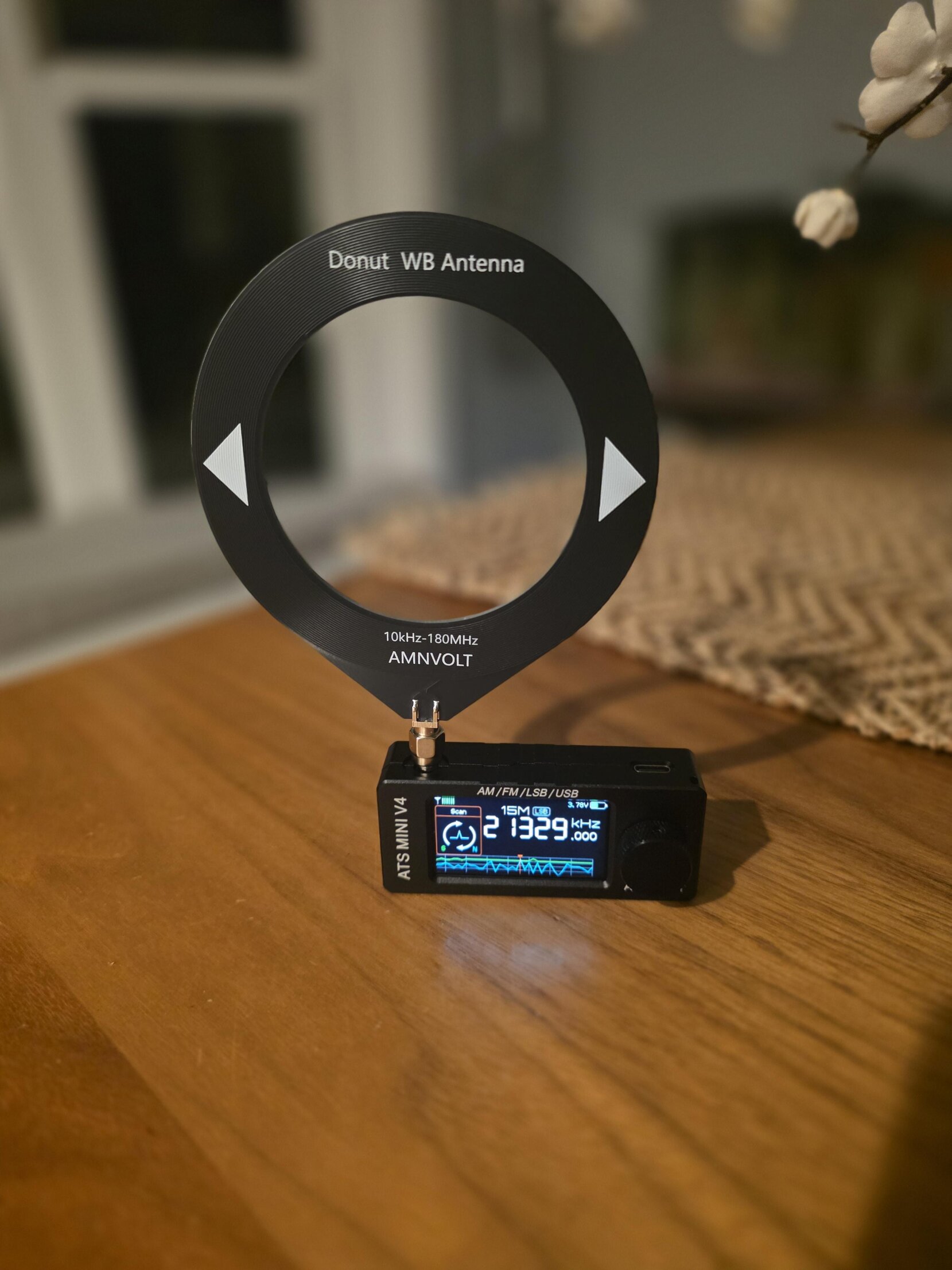
The ATS-Mini V4 with the AMNVOLT Donut WB antenna (10 kHz–180 MHz) on my desk