What if your electricity provider could tell you’re not home without ever looking out the window?
They can. Your smart meter has already done it. Every 15 minutes—sometimes every few seconds—it reports when you wake up, cook dinner, leave for work, and go to bed. That’s not just kilowatt-hours. That’s a Pattern of Life (PoL) map of your household, transmitted without your meaningful consent.
No tinfoil hat required. It’s all legal.
The question isn’t whether the data exists—it does, and it should, for grid modernisation. You can’t optimise a system you can’t measure. But who owns it, who controls it, and who profits from it?
Spoiler: It’s not you.
Two Views of the Same Data
Two dashboards from my property on the same day:
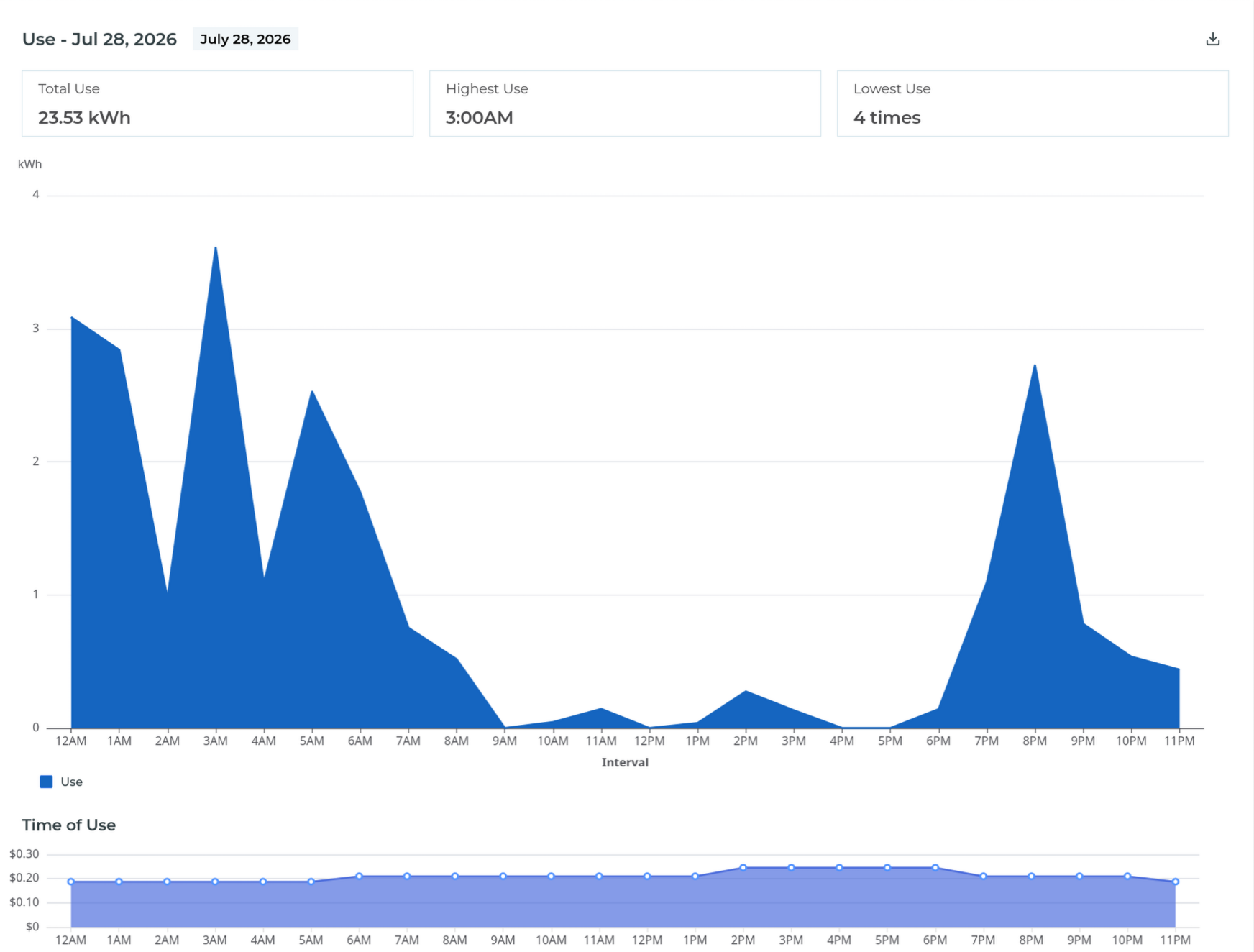
This is what my utility sees. Single aggregated line. Total: 23.53 kWh. Highest spike at 3:00AM. Four low-use periods scattered across the day.
Now compare it to this:
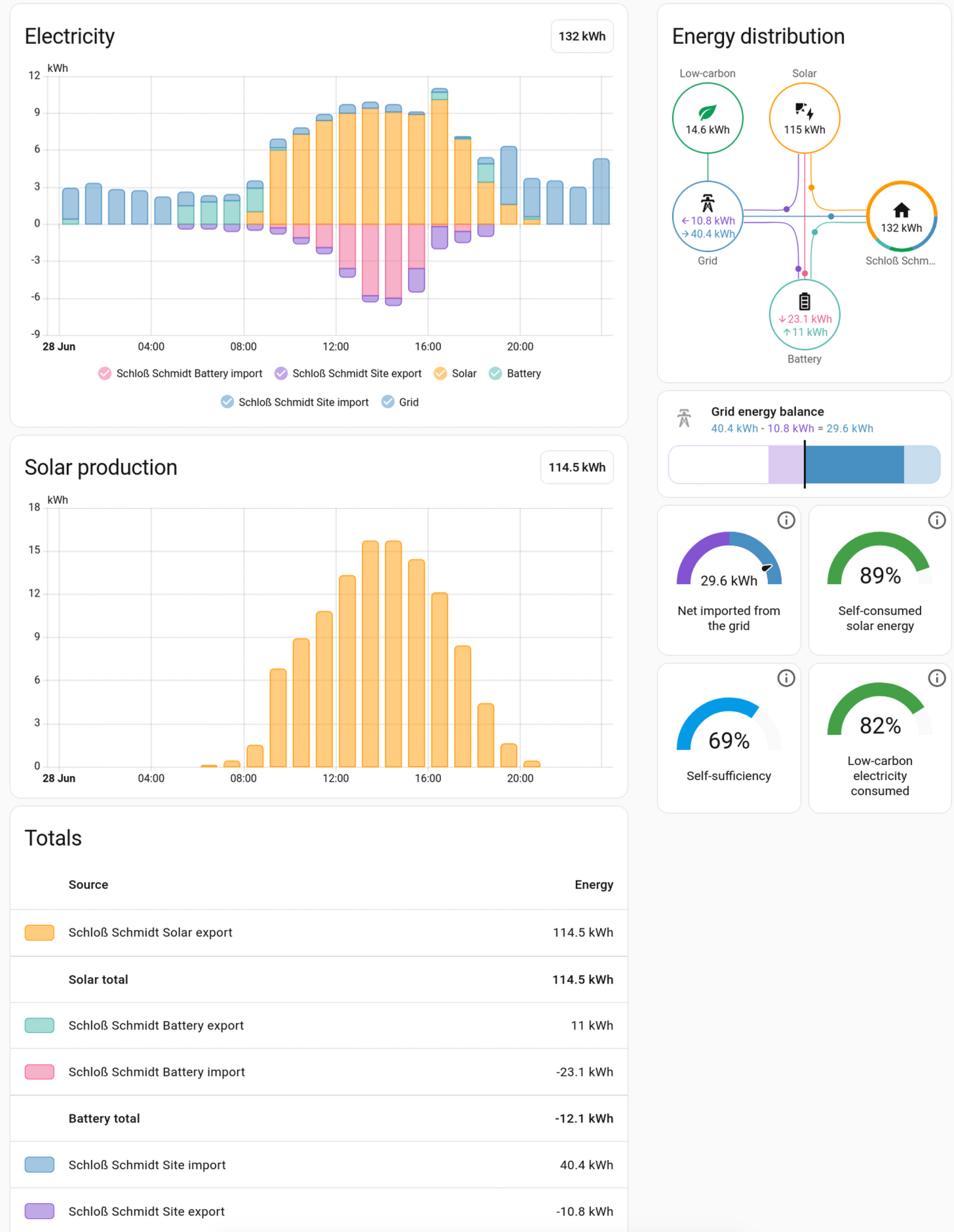
My own monitoring shows granular detail – solar production (114.5 kWh), battery flows, 89% self-consumed solar energy, 69% self-sufficiency.
My solar array and battery buffer mask a significant portion of my real consumption from the utility. When the sun’s up and the battery is cycling, the grid-side profile flattens. The utility doesn’t see my HVAC kicking in. They don’t see the kettle boiling. The battery absorbs those transient spikes before they ever reach the meter.
That’s accidental privacy. And it’s temporary.
The presence of solar and battery infrastructure is itself a data point. The export signature, the midday negative draw, the distinctive charge/discharge curve of a battery system – they’re all there in the aggregated line. An analyst doesn’t see appliance-level consumption, but they see enough to know:
| Signal | What It Reveals | Confidence |
|---|---|---|
| Night spike at 3:00AM | Battery charging, EV charging, or high-load appliance cycle | High |
| Near-zero draw 09:00–17:00 | Work-from-home pattern OR house empty during work hours | Medium |
| Evening surge at 20:00 | Return home, HVAC, cooking, entertainment load | High |
| Total 23.53 kWh/day | ~70 EUR/month electricity cost (income bracket indicator) | High |
Multiply this across millions of households. That’s a national-scale surveillance network.
Europe Gets It (Mostly) Right: GDPR and Smart Meter Privacy
Europe treats consumption data as personal data under GDPR. That means lawful basis for processing, purpose limitation, and data minimisation. But utilities define “legitimate interest” broadly – operational necessity, grid management, demand response. Secondary commercial use is technically restricted, but exemptions are wide enough for data broker partnerships.
Specific EU protections that matter:
| Directive/Regulation | What It Requires | Status |
|---|---|---|
| GDPR Art. 6(1)(a) | Explicit consent for processing personal data | Enforced, but buried in 40-page contracts |
| GDPR Art. 21 | Right to object to legitimate interest processing | Rarely exercised by consumers |
| Smart Metering Code (EU 2019/944) | Data security, access control, customer choice | Member states implementing variably |
| NIS Directive | Critical infrastructure cybersecurity requirements | Applied to utilities, not consumer data |
| Digital Operational Resilience Act (DORA) | Enhanced tech risk management for financial/energy sector | Coming into force 2025 |
Member states implement these differently:
| Jurisdiction | Model | Status |
|---|---|---|
| Germany | Messstellenbetriebsgesetz – strict separation of metering and commercial data | Strong consumer protections |
| UK | Smart Code Data Sharing Requirements – mandatory opt-out mechanisms | Functional but complex |
| Netherlands | Smart meter opt-out available, data access limited to authorised parties | Best-in-class implementation |
| Spain | Customer Data Access Portal – download your consumption history | Growing adoption |
| France | Linky smart meters with privacy mode option | Controversial rollout |
The Netherlands’ approach is instructive: customers can opt out of granular data collection, request their consumption history in standard formats, and challenge unauthorised access. Germany separates metering operators from utilities entirely – reducing conflicts of interest.
None of these frameworks is perfect. But they represent movement toward accountability. The US, meanwhile, still operates under the third-party doctrine.
The Ownership Ambiguity: US vs EU
Who owns the data?
| Claimant | US Position | EU Position |
|---|---|---|
| Utility | They installed, own, and maintain the meter | They operate the infrastructure, not the data |
| Customer | Moral argument only | Legal right under GDPR (Art. 15–21) |
| Shared/Stewardship | Emerging in some states | Default framework in most jurisdictions |
| Public Good | Framed as national security | Framed as public service with privacy safeguards |
In the US, law enforcement relies on the third-party doctrine (Smith v. Maryland, 1979) to access utility data without warrants. You gave it to them voluntarily, so you forfeit Fourth Amendment protection. Applied to modern smart meter telemetry, this creates an absurd situation: your entire home life is exposed because you wanted to pay your bill electronically.
Here’s where the battles are happening:
Naperville Smart Meter Awareness v. City of Naperville (2018, Seventh Circuit): A consumer group challenged Naperville’s mandatory smart meter program. The court held that granular smart meter data collection IS a search under the Fourth Amendment, rejecting the third-party doctrine argument. The utility argued customers “voluntarily shared” data by using electricity. The Seventh Circuit disagreed: “the data reveals intimate details of life within the home.” But then the court found the search reasonable anyway, balancing grid modernisation interests against diminished privacy expectations. The ruling never addressed law enforcement access separately. Result: Fourth Amendment applies, but police can still get the data without a warrant.
Carpenter v. United States (2018, US Supreme Court): Not about smart meters specifically, but about cell-site location information. The Court held that warrantless access to historical cell tower data violated the Fourth Amendment, carving out an exception to the third-party doctrine for “comprehensive” digital records revealing intimate life patterns. Several district courts since have cited Carpenter to require warrants for smart meter data. Other courts continue following Smith. The circuit split is widening.
The Regulatory Patchwork: State PUCs
While federal privacy law lacks a GDPR equivalent, the US energy market isn’t a total legal vacuum. Commercial data sharing is regulated at the state level by Public Utility Commissions (PUCs).
Major jurisdictions enforce Customer Energy Usage Data (CEUD) rules—such as California’s CPUC Privacy Rules (D.11-07-056) or Texas PUCT tariffs—that legally bar utilities from selling personally identifiable interval data to third-party marketers without explicit, affirmative consent.
The primary regulatory vulnerability in the US isn’t utilities outright selling raw load curves to ad networks. Rather, it’s:
- Vague “operational partnership” clauses buried in service agreements.
- Data sharing with third-party vendors under the guise of grid management.
- The sale of “anonymized” or aggregated datasets that can be re-identified when combined with external consumer records.
What Your Load Curve Says About You
Household Size and Composition
- Single occupant: One morning spike, flat midday, one evening spike, then baseline. Predictable.
- Family with school-age children: Sharp morning spike 06:00–07:30, midday flatline, afternoon re-spike at 15:00–16:00.
- Multi-generational household: Sustained daytime draw (elderly home during business hours), irregular evening peaks.
A trained analyst can estimate household size within +/-1 person from a week of 15-minute interval data. Your meter filed it for them.
Income and Wealth Indicators
NILM (Non-Intrusive Load Monitoring) algorithms disaggregate aggregate draw into device signatures:
| Signal | What It Reveals | Confidence |
|---|---|---|
| Central air conditioning cycling | Home with ducted HVAC (higher-value property) | High |
| EV charging plateau | Vehicle ownership, disposable income tier | High |
| Pool pump signature | Disposable income, property value indicator | High |
| Solar export signature | Homeowner with capital for solar investment | High |
Insurance actuaries would pay handsomely for this. And they do – just through intermediaries.
Health and Medical Device Signatures
Certain medical devices have distinctive load profiles:
- CPAP machines: Sustained low draw (30–60W) exclusively during overnight hours. Sleep apnoea diagnosis.
- Dialysis machines: Regular high-draw sessions (200–400W for 3–4 hours) at fixed times. Chronic kidney disease.
- Oxygen concentrators: Continuous 300–500W draw, 24/7. Advanced respiratory condition.
NILM research from German and UK universities demonstrates >85% accuracy in identifying these devices from aggregate household load. Research from Fraunhofer Institute in Germany and University of Bristol’s UK-DALE project has validated these findings in clinical home-care settings. The data is in your utility’s database right now.
The Data Pipeline
Smart meter infrastructure is opaque to most customers:
| |
At each hop, legal protections thin out.
What the utility knows:
- Granular consumption timestamps
- Peak usage windows and device signatures (via NILM)
- Absence patterns
- Appliance inventory
- Household composition indicators
What third parties learn: Utilities license this data to demand-response aggregators, weather analytics firms, and – increasingly – data brokers selling “energy insights” to marketing firms. The line between operational necessity and commercial exploitation is deliberately blurred.
Hacker Exploitation
Hackers don’t need to breach your router. They just need access to the utility’s customer portal – or a third-party data broker selling aggregated datasets.
| Vector | Method | Outcome |
|---|---|---|
| Credential stuffing | Leaked utility portal creds sold on dark web marketplaces | Historical usage data, billing info, contact details |
| API abuse | Unauthenticated endpoints in utility mobile apps | Bulk export via IDOR vulnerabilities |
| Insider threat | Utility employees accessing data without authorisation | Direct sale of customer PoL to criminal actors |
| Supply chain breach | Compromised AMI head-end software vendor | Millions of records exfiltrated |
Burglary crews cross-reference neighbourhood-level data dumps with property records. Flatline consumption Tuesday through Friday? Occupants are at work. Weekend travel signatures flag absence for targeted break-ins.
Advertiser Profiling
Chrome is deprecating third-party cookies. The advertising industry is scrambling. Smart meter data is the perfect substitute.
Why it works better than tracking pixels:
- Persistent: Can’t opt out without going off-grid
- Cross-device: Aggregates all household activity under one address
- Difficult to falsify: Physical reality leaves traces in the load curve
- Longitudinal: Years of historical data available for trend analysis
Marketers infer income brackets, family size, health conditions, homeownership status, and travel frequency. This data feeds into lookalike audiences, dynamic pricing models, insurance risk assessments, and mortgage affordability calculations.
For many households, sharing this data isn’t a casual choice—it’s an economic reality. Smart meter telemetry enables Time-of-Use (TOU) pricing, outage detection, and grid balancing that lower energy bills for families who can’t afford private battery buffers or solar arrays.
My own solar and battery setup grants me a layer of accidental privacy, but that’s a luxury of capital. The core problem isn’t that smart grids exist—they are essential for integrating renewable energy and preventing blackouts. The problem is that non-wealthy consumers are forced into an unfair bargain: accept granular behavioral surveillance, or pay significantly higher rates just to keep the lights on.
Law Enforcement Access: The Third-Party Doctrine Loophole
Police don’t need a warrant. They rely on the third-party doctrine.
What this means in practice:
- Police issue a subpoena, not a warrant
- Subpoena requires lower legal threshold than probable cause
- No judicial review of the request
- No requirement to notify you afterward
Law enforcement has used smart meter data to confirm residence patterns, validate alibis, identify cannabis grows, corroborate wiretap evidence, and establish probable cause for physical surveillance.
The ACLU challenged this practice in California. In 2025, a Sacramento County Superior Court ruled that the Sacramento Municipal Utility District (SMUD) violated state privacy law by sharing detailed smart meter data from over 33,000 homes with police without warrants. The court rejected the claim that this violated the California constitutional search and seizure clause, but found the data-sharing program illegal under state privacy law. The ruling is narrow. Other courts remain split.
If police can get your location history from cell towers with a pen register order, they can get your PoL from your meter the same way. And unlike cell site location data – Carpenter v. United States (2018) – smart meter access remains largely unchallenged.
Consumer Rights: What You Actually Control
Immediate actions:
Demand Opt-Out Options – Most utilities offer smart meter opt-outs for $5–$30/month. It’s a tax on privacy, but it’s yours to pay if you value anonymity. Request an analog meter replacement in writing.
File Privacy Complaints – Report data-sharing practices to your state PUC. Document vague consent forms and hidden clauses. Collective complaints trigger regulatory scrutiny.
Block Telemetry on Your LAN – Smart home devices aggregate usage data before transmission. Disable cloud syncing. Run a Pi-hole to block telemetry endpoints.
Medium-term mitigations:
Load Masking – Run a programmable dummy load when your baseline drops. A 1kW resistive element obscures your absence patterns and flattens device signatures that NILM algorithms rely on. Cheap hardware, effective obfuscation.
Energy Storage Buffers – Battery systems smooth the grid-side profile. The utility sees constant draw. Your internal fluctuations stay private.
Operational Randomisation – Don’t run heavy loads on a fixed schedule. Vary washing machine times. Introduce entropy into your consumption pattern. Predictability is the enemy of privacy.
Long-term advocacy:
- Colorado’s HB25-1175 (Smart Meter Opt-In Program, signed May 2025) requires utilities to offer opt-in programs for smart meters and publish data privacy information.
- Similar bills pending in California, New York, Illinois
- Federal Privacy of Energy Consumption Data Act stalled in committee
Contact your representatives. This is where change happens.
The Trade-Off Nobody Made For You
Smart grids promise efficiency, resilience, and sustainability. None of that requires your household to be broadcast in high definition.
The infrastructure is already deployed. The data is already flowing. The third parties are already monetising it.
You have three choices:
- Pay the opt-out fee and accept the inconvenience
- Implement technical countermeasures and accept the complexity
- Advocate for regulatory reform and accept the timeline
Europe has the regulatory framework for the right approach. The US needs to catch up.
Read next: Reclaiming Your Nordic Track: A 2026 iFit Bypass Guide – Stripping vendor lock-in from your IoT ecosystem, one ADB command at a time.
Also read: Reclaiming Control: Why Open Data Formats Matter – The case for vendor-agnostic architecture in enterprise systems.
Tags: #Privacy #PatternOfLife #SmartMeters #SurveillanceCapitalism #DataGovernance #ConsumerProtection #CivilLiberties #CriticalInfrastructure #GDPR