BLUF: If we keep burning junior talent today, we will have nobody to inherit tomorrow. The industry’s loss of patience with entry-level devs is creating a 20-year problem we are refusing to see.
The Vanishing Entry Level
Had a good conversation with fellow geeks Fernando Covatti and Dávid Kőszeghy about AI and junior programmers as we think about talent.
- Everybody is losing patience with juniors.
- Fair enough; they need hand-holding, they make mistakes, and they cost time.
- But here is the question nobody is answering: what happens in 20 years when the current senior engineers are retired?
I think about this because I lived a version of it.
Lessons from the Fortran Frontier
Years ago (many), I was porting code off an SGI NUMA MIPS cluster system.
- You needed a security clearance, a need-to-know, and you needed to know Fortran.
- Oddly enough, the last part of that was the hardest to find.
- The original Fortran programmers were already retired and would come into work only when they felt like it.
- We needed them far more than they needed us!
No juniors picked it up; I was the closest thing they had. It was great for me and great for them, as we were in high demand. Eventually, I ported their Fortran to something more modern, and after that, they were not needed outside occasional debugging.
That is how cycles work. The work changes. The people who adapt stay relevant. The ones who do not, do not.
The AI Shift: Evolution, Not Extinction
Maybe that is exactly what happens here with AI. Programming changes. They do not need us anymore—at least not the way we work today.
“AI is like assembly language. The way we program will be different. AI is just an evolution, not an extinction.” — Linus Torvalds
Juniors usually have more energy than seniors, but they need seniors to channel that energy. If AI absorbs the entry-level coding work that juniors cut their teeth on, where does that leave them? It seems the industry is debugging its talent pipeline by simply deleting it.
The Hard Data
According to US software developer employment data (ADP payroll data, indexed to Oct 2022), the post-ChatGPT landscape shows a stark generational divide:
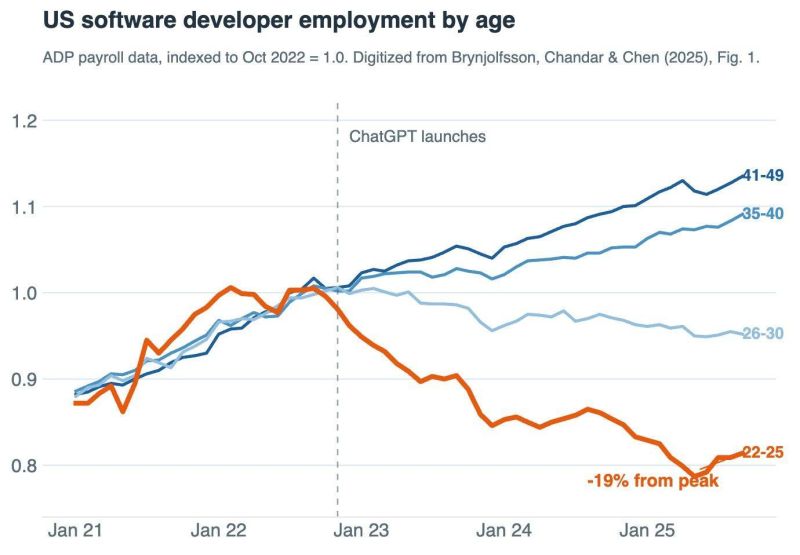
- Ages 41–49: Steady climb.
- Ages 35–40: Moderate growth.
- Ages 26–30: Plateau, then decline.
- Ages 22–25: Down 19% from peak, dropping hard post-ChatGPT.
The newest cohort is getting hit hardest, while the oldest is accelerating and the middle is holding on.
Judgment Cannot Be Automated
- Energy spent on pure coding is no longer the scarce resource; judgment is.
- Judgment does not come from a tutorial or a code suggestion.
- It comes from years of breaking things, fixing them, and learning from the shrapnel.
If we stop investing in juniors now, we are not saving money. We are simply deferring a massive bill that will come due in 20 years—with a terrifying amount of interest.
Note: Junior & Senior are not indicative of age, but experience. I know many programmers who started in their 40s and are amazing engineers.