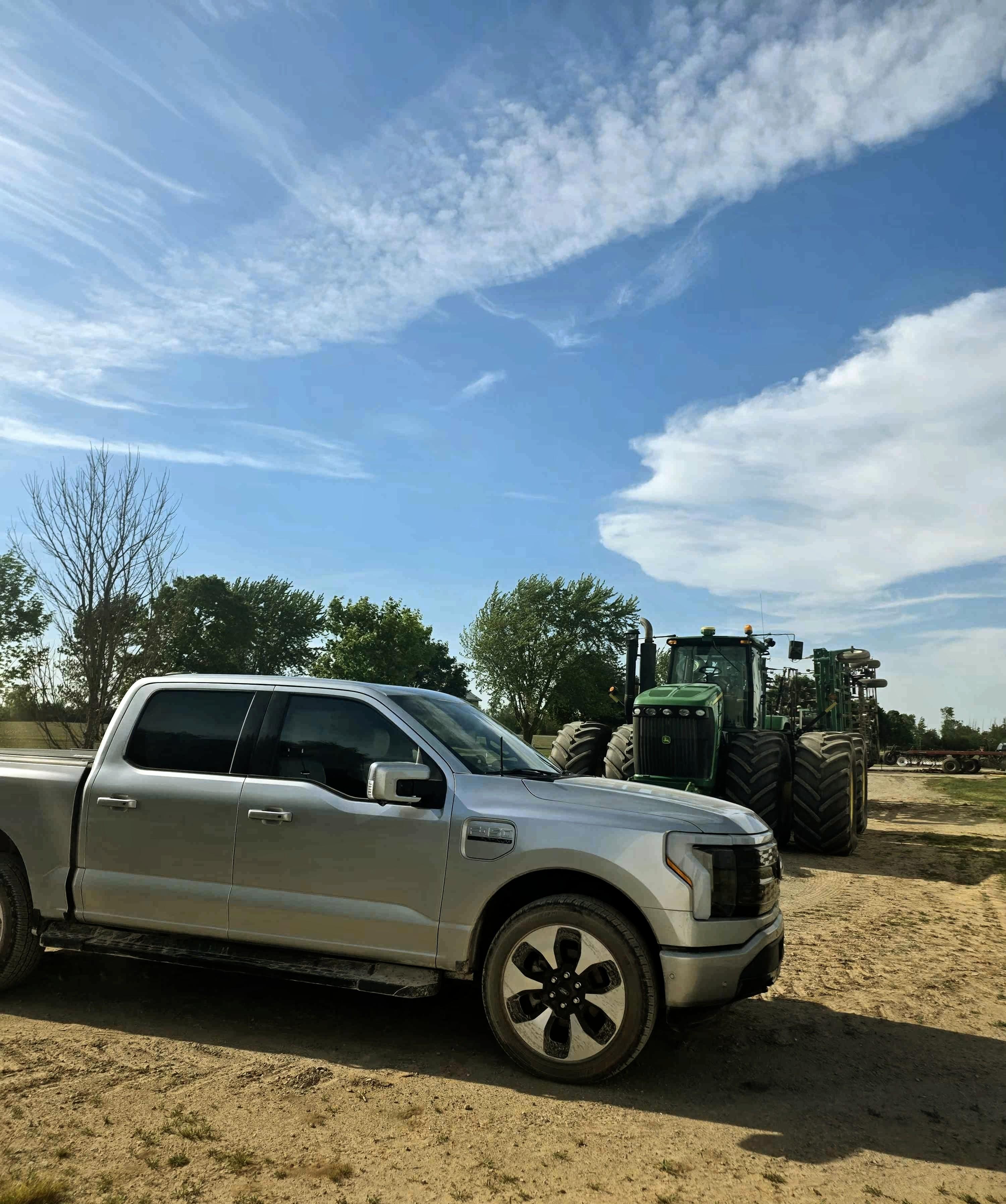
I recently wrapped up an interview with the Michigan Advance that caught me off guard. Sitting down to chat about my Ford F-150 Lightning made me realize something wild: it has been nearly four years since I took delivery of the very first one.
You can read the full piece here: Ford may have ditched the Lightning, but its first buyer hasn’t.
A lot of life changes in four years. The automotive industry has shifted dramatically, political administrations have flipped EV policies upside down, and Ford has even pulled the plug on the next-generation Lightning line. Yet, here I am, roughly 65,000 kilometres (40,000 miles) later, still driving it.
After four years of real-world use, towing, and family utility, here is the honest, unvarnished truth about what it’s actually like to live with this truck.
The Best Feature: It’s Just an F-150
The greatest compliment I can give the Lightning is that, at the end of the day, it is just an F-150.
It does not try to reinvent the steering wheel or hide basic functions behind endless layers of glass menus. This matters. Recently, my mum was driving my Tesla Model 3 and completely froze because she couldn’t figure out how to put the thing in park.
With the Lightning, my parents can hop in, grab a physical shifter, put it in drive, and go pick up a ton of rock or some groceries from Meijer. There is no spaceship complexity. It is an honest-to-God truck that happens to run on electrons.
The Crunching Numbers: 65,000 Kilometres Later
Whenever people find out I drive an EV truck, the very first question is usually about the cost. Now that I have crossed the 65,000-kilometre mark, I finally have the long-term data to show exactly how the economics stack up compared to a traditional petrol truck.
Because I do the vast majority of my charging at home overnight, I take advantage of Michigan’s super off-peak electricity rates, which have averaged around $0.17 per kWh over the last few years. The Lightning averages about 32 kWh per 100 kilometres in mixed driving conditions.
- Total Electricity Cost: Shifting my charging to those overnight hours means it has cost roughly $3,500 in electricity to clear that 65,000-kilometre distance.
- The Petrol Alternative: If I had driven those same 65,000 kilometres in a standard V8 F-150 averaging about 12 litres per 100 kilometres, the math changes drastically. With Michigan petrol prices fluctuating wildly but averaging roughly $0.95 per litre ($3.60 per gallon) over the last four years, I would have dumped at least $7,400 into a petrol tank.
Purely on fuel, the truck has saved me nearly $4,000.
Factoring in the Total Cost of Ownership (TCO)
The real divergence happens when you look at actual mechanical maintenance. Beyond switching out windshield wipers and filling up washer fluid, my absolute total expenditure on mechanical maintenance over four years and 65,000 kilometres has been exactly one replacement tyre. No oil changes, no transmission flushes, no spark plugs, and no exhaust service.
When you look at the total cost of ownership compared to a petrol-powered V8 F-150 over this exact same timeframe, the difference becomes stark:
| Expense Category | Ford F-150 Lightning (EV) | Ford F-150 V8 (Petrol Estimate) |
|---|---|---|
| Energy / Fuel | ~$3,500 | ~$7,400 |
| Scheduled Maintenance | $0 | ~$800 (Oil, filters, fluid checks) |
| Wear & Tear / Repairs | ~$300 (Single tyre replacement) | ~$700 (Full tyre rotations, minor components) |
| Total Operating Cost | $3,800 | $8,900 |
By keeping the maintenance checklist down to effectively zero and maximizing off-peak home charging, the running costs are less than half of an internal combustion engine variant. It is a massive win for daily operating costs, though as the interview pointed out, you still have to weigh that operating TCO advantage against the initial higher purchase price of the EV platform.
The Good, the Bad, and the Ugly
Living with a first-generation vehicle means finding the quirks that a design studio missed. Here is my current laundry list:
- The Wheels are Asinine (The Ugly): The stock rims are a logistical nightmare if you actually use a truck like a truck. They have these deep pockets that act like a scoop, picking up mud, clay, and dirt inside them, which throws off the wheel balance. The second these tyres are shot, I am switching to a setup with significantly more tyre and much less rim.
- The Bed is Too Short (The Bad): I consistently find myself wishing I had a longer bed like my last gas-powered truck. If you are hauling serious cargo, the short bed limits you quickly.
- Minor Hardware Fails (The Bad): The driver’s side power window is completely fubar right now.
- The Software is a Dud (The Bad): My over-the-air software updates haven’t worked since March. It is likely tied to a low 12v battery voltage issue keeping the update from triggering. The silver lining? Ford’s updates do absolutely nothing exciting anyway, unlike Tesla’s, you aren’t missing out on anything substantial when an update fails.
- Dealership Confusion (The Ugly): Dealerships still have no idea how to handle EV service or recalls. I constantly get generic “F-150 Recall” notices in the mail that only apply to the gas-powered models, leaving me to guess if my truck actually needs to go in.
The Towing Paradox
Towing with this truck is a complete dream. Because there is no traditional transmission, you never have a gearbox hunting for the right gear while pulling a heavy load through the hills. The power is just there, instantaneous and smooth. I have pulled a massive Airstream trailer all over Michigan, and from a pure driving dynamics perspective, it beats a gas truck every single day.
…Until you need to charge.
The charging infrastructure has improved significantly over the past 18 months, but towing still exposes the deep flaws in America’s infrastructure layout. Almost every fast charger is designed like a standard parking spot. If you are pulling a 6-metre (20-plus foot) trailer, you either have to awkwardly block four charging bays or completely unhitch the trailer in a random car park just to plug the truck in. It turns a quick top-up into an exhausting logistical exercise.
The “American Mindset” and the EV Truck Space
As the Michigan Advance article pointed out, my specific use case probably would have been better served by a plug-in hybrid or an EREV (Extended Range Electric Vehicle). Things are improving rapidly on that front, but it highlights the weird space EV trucks occupy right now.
When I drive around Texas for work, I see thousands of pristine, lifted trucks that have never seen a speck of dirt or towed a single pound. For drivers using them purely as daily commuters, an EV truck makes absolute sense. It’s quiet, incredibly fast, and cheap to run around town.
But it forces a larger question about our collective mindset: Why do you need that big of a truck just to go to an office? If you aren’t using the utility, a smaller car or a standard EV sedan is vastly more practical. We’ve built an American culture around massive vehicles, even when the utility isn’t required.
The Verdict
Four years in, I am still generally happy with the Lightning. It has its flaws, the infrastructure still requires careful planning, and the manufacturer has moved on to other strategies. But as a tool for moving heavy things, keeping operating costs low when petrol prices spike, and giving people a chuckle when they look in the “frunk” and ask where the engine is, it still delivers.